
Before someone could sell a scoop of ice cream, someone else had to solve a very different problem: how do you keep ice through the summer?
Then came other questions. How do you flavor it? How do you freeze a sweet mixture without turning it into a solid block? How do you make the result reliably, transport it, and sell it at a price more people can afford?
There is no universally agreed inventor of ice cream. Its history brings together traditions of cooled drinks and frozen desserts, culinary experimentation, and changes in machinery and trade. The familiar stories of a single recipe traveling neatly from one civilization to the next are often difficult to prove.
That makes the broader story more interesting. Ice cream offers a way to see innovation as accumulated contributions: people solving different problems, in different places, whose knowledge eventually becomes part of something shared.
Persia: making cold available
In Iran, traditional ice houses known as yakhchals stored ice collected or made in winter for use during warmer months. Some combined deep storage pits, thick earthen construction, shade walls, and shallow basins where water froze on cold nights. Their design worked with the local climate. Encyclopaedia Iranica documents these structures and their operation.
The innovation here was infrastructure. Before a cold drink or frozen dessert could become a dependable offering, someone had to make cold available when people wanted it. A seasonal resource became something that could be stored and distributed.
This does not establish that a particular ice house produced the first ice cream. It shows something more useful for understanding innovation: the finished product may depend on an earlier solution that customers barely notice.

Across the Middle East: a language of flavor
Persian, Arab, and Ottoman food traditions include sweet drinks and syrups associated with names such as sharbat and sherbet. Fruit, flowers, sugar, and cooling offered many ways to make refreshment distinctive. These traditions belong to a wider history of exchange, rather than a single region replacing everyone else’s method.
Nor were all sherbets frozen, or all frozen sweets dairy-based. The important connection is the knowledge of combining sweetness, aroma, and cold. Food writer Najmieh Batmanglij describes syrup served with crushed ice or snow in Persian tradition.
For an innovator, the lesson is about ingredients as capabilities. A syrup can carry a flavor into another preparation. A technique can travel even when the finished dish changes. What looks like a new product may be an existing piece of knowledge finding another use.
Italy and Europe: changing the experience
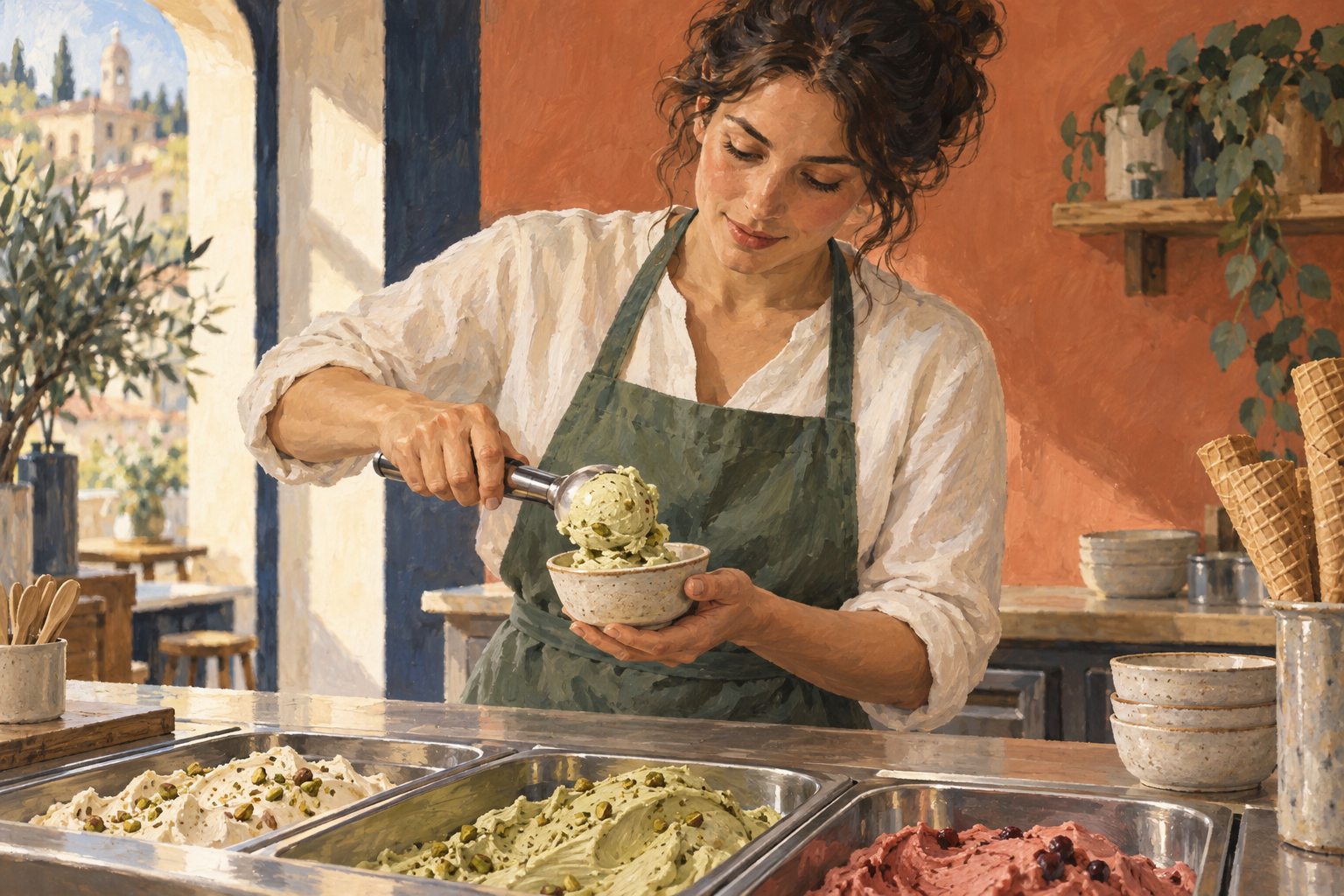
Italian makers played an important role in the development and spread of European frozen desserts. London Museum describes sweetened milk ices appearing in Europe through Italy in the seventeenth century, while acknowledging the disputed origins and much older traditions of chilled foods in Persia and China. Its history follows both the recipes and the people who carried them.
Milk, cream, and sometimes eggs opened possibilities beyond flavored ice. But richness alone does not produce a smooth dessert. The proportions of ingredients and the freezing method matter together. The British Museum’s account of confectionery emphasizes how carefully sugar had to be measured to achieve a workable texture. Recipes made that practical knowledge easier to share.
The change was in the whole experience: texture, flavor, serving, and occasion. Local craft turned available ingredients and techniques into something people came to recognize and value.
Process and distribution: making pleasure repeatable
Making ice cream once and making it reliably for many customers are different challenges. In 1843, Nancy Johnson patented a hand-cranked freezer in the United States. It combined an inner churning chamber with an outer container for ice, making the work more manageable. The Smithsonian explains the design and the labor it still required.
Further improvements in freezing equipment, refrigeration, and production helped expand what businesses could offer. Distribution mattered as much as the recipe. In nineteenth-century London, Swiss Italian entrepreneur Carlo Gatti worked in both the ice trade and ice-cream selling. Supplying the cold and reaching the customer were parts of the same opportunity.
This is a recurring pattern: a better process can unlock a market that a good product alone cannot reach.
The value is in the connections
These are overlapping contributions, not four exclusive national claims. Infrastructure makes a resource available. Ingredients create new possibilities. Process makes quality repeatable. Distribution brings the result within reach.
That is why this story matters beyond dessert. A business may have a useful product but lack a reliable supply, a workable process, or a way to reach customers. The next valuable idea might solve one of those conditions rather than change the product itself.
At Localize This Idea™, we ask what an idea is trying to achieve, how it works, and what has to be true for it to succeed. Ice cream invites the same questions. The objective may remain recognizable, while the ingredients, tools, partnerships, and route to the customer change from place to place.
A question to take with you
Which missing piece could someone elsewhere already have solved?
Choose a product or service you know. Look beyond its visible features to its supply, process, and distribution. Where could knowledge from another place make the whole offering work better?
Explore Discovery ↗Watch and explore further
Your starting point for this story: “Who Invented Ice Cream?” featuring Dr. Roy Casagranda. Explore the historical sources linked throughout the article for more detail on ice storage, recipes, makers, and machinery.